 Water Damage Restoration Phoenix
Water-Damaged Flooring & Subfloor Repair Phoenix
The core decision is whether a floor dries out or comes out. Solid hardwood and a plywood subfloor can often be saved if drying starts within 24, 48 hours; a moisture meter reading under 12% in wood usually means the…
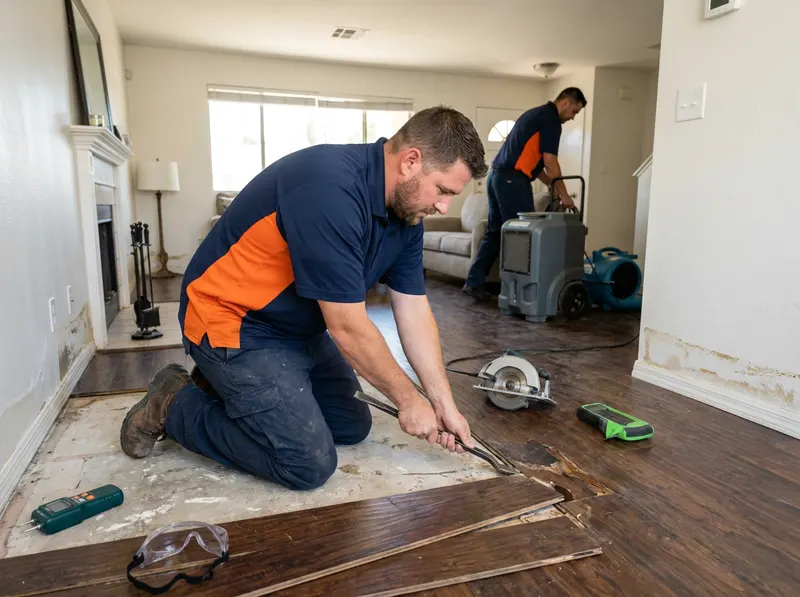
- Included: moisture mapping with a meter, structural drying of the subfloor, removal of unsalvageable material, and reinstallation of new flooring.
- Timeline: drying runs 3, 5 days on average; full repair and reinstall typically adds 2, 7 days depending on flooring type.
- Cost: most Phoenix flooring and subfloor repairs land in the $600, $6,500 range; the exact figure is confirmed after an on-site moisture reading.
- What we remove: swollen laminate, delaminated engineered wood, warped subfloor plywood, and carpet pad that stayed wet past 48 hours.
- To book: call or text a photo of the affected floor for a same-day ballpark; on-site inspection confirms the number.
The core decision is whether a floor dries out or comes out. Solid hardwood and a plywood subfloor can often be saved if drying starts within 24, 48 hours; a moisture meter reading under 12% in wood usually means the material is stable enough to sand and refinish rather than replace. Laminate and engineered planks that have already cupped or delaminated do not recover and are removed. Carpet is frequently salvageable, but the pad beneath it is discarded once it has held water longer than 48 hours because it traps moisture against the subfloor and grows mold.
Slab-on-grade homes across Phoenix behave differently than raised-floor construction. Much of Maryvale, Laveen, and Ahwatukee Foothills sits on concrete slabs, where water spreads under tile and wood and wicks sideways into walls; here the repair centers on drying the slab with air movers and confirming a moisture reading before any new flooring is glued down. Older raised-floor and hardwood homes in Willo Historic District and Encanto-Palmcroft have plywood subfloors and joists that can rot if the drying is rushed, so those jobs include checking the framing below the subfloor, not just the surface.
The sequence on arrival is straightforward. First, a technician maps the wet area with a moisture meter and marks the boundary. Second, unsalvageable surface material and wet pad are removed to expose the subfloor. Third, air movers and a dehumidifier run until the subfloor reads dry, verified with repeat meter readings. Fourth, damaged subfloor sections are cut out and replaced with matching plywood or the slab is prepped. Fifth, new flooring is installed and the room is returned to pre-loss condition. A single-room job in Arcadia or North Central Phoenix moves faster than a whole-floor loss in a Desert Ridge or Paradise Valley Village home, where multiple rooms of tile and wood may be involved.
Insurance guidance is part of the process. Photos of the standing water, the moisture readings, and an itemized scope of removed and replaced materials are documented so the claim reflects the actual damage. A clarification that saves confusion: flooring repair is not the same as water extraction, extraction pulls the standing water out, while this service dries the structure and rebuilds the floor above it. Both may be needed after a burst supply line or a Sunnyslope monsoon backup, and they are quoted as separate line items.
Water-Damaged Flooring & Subfloor Repair cost in Phoenix
Every job gets a firm, written price after a free on-site visit.
Common questions
Can water-damaged hardwood be saved in a Phoenix home, or does it always get replaced?
How long does subfloor drying take in a Phoenix water damage job?
Does flooring repair in Phoenix include the concrete slab underneath?
What does water-damaged flooring repair cost in Phoenix?
Will insurance cover subfloor replacement after a leak in my Phoenix home?
Get started today
Tell us about your water-damaged flooring & subfloor repair job in Phoenix and we'll send a clear, written quote, usually the same day.